Monday, March 28, 2016

The Resurrection and Apollo XIII

“Who would believe what we have heard?”
—Isaiah 53:1
 
The Resurrection of Christ certainly makes for a riveting story, but is it reasonable?  In the end what is reasonable or unreasonable depends on the base premises involved. For many, the Resurrection generally adheres to one of three premises—lies, lunacy or legend.
  • The early Christians intentionally deceived others about the risen Christ.
  • Or they were delusional enough to actually believe it.
  • Or stories about Jesus were exaggerated over time into an elaborate myth.
Remember that early Christians were not converted by the sword. In fact, it was the precise opposite. If you did convert, you would face “the sword” or at least by ostracized from your already established culture and community. In the logic of the human condition, people will follow the path of least resistance without a strong impetus to do otherwise. Would mere stories convince so many without other compelling evidence? There are exceptions to every rule, but it’s easier to do nothing than to turn your life upside-down listening to the legends of liars and lunatics. But suppose they already felt ostracized by their culture and were desperately looking for a revolution and a savior? This would have plausibly appealed to the “fight or flight” instinct, but the new Christian faith was not about taking up weapons or running away from problems.
The other leg of “legend” or “myth” was covered in my last post. I think the myth theory runs into a serious problem with “time”. Some may still dispute the first-century date for the Gospels, but no one disputes that Paul's letters were written within the lifetime of eyewitnesses to Christ. If so, there is not even one generation with which to build-up such a fantastic myth as the Resurrection, which was indispensable to the early Christian faith.
The Resurrection might still be dismissed as not credible simply because that sort of thing just doesn’t happen. The paradigm that says “that just doesn’t happen” is one reason for using analytical problem solving, which trains people to go wherever the data leads, and on occasion it leads us to places in spite of our intuition and our experience. One of the case studies we review in a problem solving class I teach where I work is the Apollo XIII disaster. I’m more familiar with accident than the average person and one aspect of it reminds me of the Resurrection.
Apollo XIII was well on its way to the moon when at fifty-four hours and fifty-two minutes into the flight the origin of that famous phrase was born; “Houston, we have a problem.” The word “problem” is an overgeneralization; the first specific deviation reported to Houston was “Main Buss B undervolt”. This meant that one of the two main power distribution panels for the command module had fallen off in electrical output. A “large bang” was another deviation reported at the same time as the first. A few minutes later another deviation was reported; Main Buss A undervolt. Apollo XIII was suddenly losing electrical power and no one knew why.

Engineers on the ground immediately began some incident management (action to the effect) by reducing electrical consumption on the ship. About thirteen minutes after reporting the first deviations more came in. There was a sudden loss of oxygen in one of the two main cryogenic oxygen tanks and a gradual loss of oxygen in the other (oxygen was used on the ship not only for breathing, but also to generate electricity. I’d imagine this was because batteries powerful enough for the ship would have had been too heavy to take into space). The ship’s crew also reported that the ship was “venting” something out into space. With the ship rapidly losing both electricity and oxygen 205,000 miles away from earth the situation could hardly have been any more critical.
While putting contingents in place to deal with the problems effects, NASA engineers also began analytical problem solving to find the cause. This was done even though they had no possibility of amassing all the data they would have liked. After analyzing whatever relevant data was available, the number two oxygen tank suddenly bursting was a possible cause that explained all the observed deviations better than anything else suggested. There was one difficulty with this proposed root-cause. NASA engineers knew that their equipment was the best and safest ever invented. The very idea of a main oxygen tank just bursting in deep space was simply not credible; this is what their experience and intuition told them.
 
Faulty instrumentation or what we might call “bad data” was another proposed cause.1 This idea may have made some people feel better. If true, it would mean that the gauges and alarms were just malfunctioning. If the gauges and alarms were “lying” or “acting crazy” so-to-speak, then there was no real danger and the mission could probably continue. Although I’ve never dealt with a life and death situation at work, I can relate to the true cause of a complex and costly problem eluding us because it was counter intuitive; it flew in the face of our knowledge, experience and intuition. When this happens the natural tendency is to pick a theory you like better and then build-up assumptions until it fits all the available facts. Preferred possible causes tend to be under scrutinized, while unwelcome possible causes tend to be over scrutinized.

The cause was indeed a rupture of the number two cryogenic oxygen tank. This cause could have been easily dismissed because “that just doesn’t happen”, but this is where all the data lead and the engineers were disciplined enough to go there. Clear-headed logic in a crisis saved the crew. Had the true cause remained unknown much longer, it would have delayed the planning to get the crew back home and there was no time to spare.
Houston celebrates the return of the Apollo XIII crew.
If there were no oxygen tanks on board, one bursting would truly be impossible. Someone insisting that the tanks did not exist would first need to be shown otherwise. Once it is made clear that the tanks are actually there, one rupturing could be at least considered. I think the same can be said in regard to Christ, His followers and the Resurrection. Even if you believe in God you can still ask questions. Were they liars, lunatics, legends or speaking “Truth”? One could answer “I don’t know”, but those willing to believe a particular theory would do well to remember the purpose of the historical method and a principle of analytical problem solving. An historian or problem solver cannot always “prove” or recreate past events. In such a case, he or she works to present a theory that will best explain the most data.
Without being either gullible or cynical, which theory explains the most data given no possibility of amassing all the data you would like to have?
“Thought is dangerous. Thought can bring you to the door of truth. There are all kinds of reasons for wanting that door to stay shut. Men cannot endure the light.”
—Anthony Esolen

1 Jim Lovell and Jeffrey Kluger, Lost Moon, (New York: Houghton Mifflin Company, 1994), p. 96.

Tuesday, March 22, 2016

I See Dead People

This is the time of year when many speak of the Resurrection. Some speak of the wonder of such a great miracle and others just wonder why so many are gullible enough to believe in such a zombie-like fairytale.

Of all the miracles in the New Testament, people rising from the dead must be the most fantastic. Even with today’s medical marvels, someone getting up as good as new after being dead for days would certainly make some headlines. Aside from the Resurrection of Christ himself, Jesus raised the son of the widow in the town of Nain (Luke 7:11-15), the daughter of Jairus (Luke 8:41-42, 49-55) and Lazarus (John 11:1-44). St. Peter raised Tabitha from the dead in the town of Joppa (Acts 9:36-41) and Eutychus was raised from the dead by Paul (Acts 20:9-12).

Real...or staged?
Think how much money a phony faith healer could make if he or she could hoax a resurrection? How famous would an illusionist or street magician become if he or she could do the same? Why have they not done so? I think it would be just too difficult to pull off. People know what death is in every age and take it very seriously. It reminds me of those who have claimed that the Apollo moon landings never happened; it was all a government hoax. I find the moon landing hoax conspiracy theory unreasonable because too many key individuals would need to be in on the hoax for it to be true. They would all need to keep their stories straight about a very serious matter for a very long time. The same would be true for a series of resurrection hoaxes, especially a series of hoaxes with specific names, places and details given. Christians had plenty of enemies back then who might act as today's political “fact checkers”; people who would be more than happy to seize upon the mistake of giving specifics to prove it was all a sham, but this never happened.

Perhaps the authors of the New Testament were not hoaxers and were not insane, but were just writing down the legends and myths that were exaggerated by the early Christians. I don’t see how a myth writer would end up with such specific names, places and details, but beyond that I think the myth theory runs into a serious problem with “time”.

Some may still dispute the first-century date for the Gospels, but no one disputes that Paul's letters were written within the lifetime of eyewitnesses to Christ.i If so, there is not even one generation with which to build-up such a fantastic myth as the Resurrection, which was obviously indispensable to the early Christian faith as we read in 1 Corinthians 15:14, “And if Christ has not been raised, then empty [too] is our preaching; empty, too, your faith.” Additionally, over five hundred eyewitnesses to the resurrected Christ are mentioned in 1 Corinthians 15:5-8. If we hold the premise that 1 Corinthians was written about 20 years after an alleged Resurrection and that the Resurrection never really happened, we can invent a modern day example to give us some perspective about the timing and scope of such an extravagant myth.
The risen MLK?
What if followers of Martin Luther King Jr. began spreading stories about him rising from the dead and ascending into heaven shortly after his assassination in 1968? Imagine all sorts of other miracles and fantastic stories were also circulated about him during his life on earth. Suppose photography and other recording devices had not been invented yet (no selfies with the risen MLK either). Would thousands of people just accept these stories even if Dr. King’s body went missing somehow? In addition to this, imagine if believing in this resurrection meant being ostracized from your community and risking ferocious persecution for both you and your family. Would people just go along with this fable without more compelling evidence or some other impetus?

Now imagine that letters were published around 1988 (20 years after the assassination) articulating how there were hundreds of eyewitness to the resurrected King, many of whom would have been still alive in 1988, and how his resurrection is now an essential part of a new and radically different religion. Is it reasonable to think that thousands of people would really give their lives to these myths? If yes, would not a rapid spread of this new religion trigger Christians and atheist alike to descend upon those poor delusional people and all the so-called “eyewitnesses” to discredit their claims or perhaps find that the eyewitnesses do not even exist?
If you hold that the Resurrection of Christ is only a myth, then this type of scenario is where your logic leads. If you hold that the Resurrection was real, then you follow a natural path of reason. More on the reasonableness of the Resurrection in a week or so.

i. Arnold Lunn, The Third Day, (El Cajon: Catholic Answers Press, 2014), pp. 120, 145. 
 

Friday, March 4, 2016

Human Rights on a Buisness Card?

Not too long ago I was working on a project with an imaging company out of Belgium for my job. One of the engineers from Belgium handed me his business card and I noticed this on the back…


It’s the complete Universal Declaration of Human Rights from the United Nations printed in ultra-fine type, strategically placed there in order to show-off their dry toner electrophotography technology. The U.S. based employees had the entire U.S. Constitution printed on the back of their business cards.
The opening line of the preamble in the UN declaration says, “Whereas recognition of the inherent dignity and of the equal and inalienable rights of all members of the human family is the foundation of freedom, justice and peace in the world…”
I was reminded of how people all over the world will universally accept certain immaterial or spiritual realities just like a “religion”. The UN declaration is certainly compatible with Catholic teaching about the dignity of the human person, but does it not also act as a secular “dogma” for many materialist, atheists and agnostics? Declaring an inherent dignity with equal and inalienable rights for all people is an extraordinary claim, and shouldn’t extraordinary claims require extraordinary evidence?
Another word for inalienable is unchallengeable and another word for inherent is in-born or in-built, but I think I can indeed challenge these claims. Should all people really be treated with equal dignity and with inalienable rights or is this just delusional thinking? What would make these rights "inherent" and what would make them "inalienable"? How can we prove things from a materialist point of view? We need empirical evidence, right? We need the Scientific Method.  What if I can show empirically how some humans are superior to others in all the ways science can measure? Would this not be clear objective evidence that some people are superior to others, which in turn proves the UN declaration to be wrong?
If your neighbor is stronger and faster than you in every measurable way, has a higher IQ in every kind of IQ test, has more assets, more friends, more people who say they love and respect him or her, how could anyone possibly say he or she is not a superior human being? What evidence would you have to prove otherwise? So if we can prove empirically that we are not equal, what is the rational basis for saying all people should be treated equally with inalienable rights if not grounded in some other, immaterial or spiritual reality?
For example, the presidential election season has been gearing up for a while now. If your neighbor makes more money, pays more taxes and has a higher IQ than you, shouldn’t that persons vote in an election count more than your vote does? Does this not make perfect sense based on the empirical evidence? If not, what evidence would you show to prove differently? Think about it...
It seems, deep down, we know that spiritual realities like inalienable rights exist outside of human opinion or empirical data, but many have trouble admitting it because it points to so much more. We also sense that we need to live harmoniously with these spiritual realities in order to be happy, so it is vital that we all strive to know what they really are and where they really come from.

One of my all-time favorite quotes is in order…
"I believe in God as I believe the sun had risen, not because I can see it, but because by way of it, I can see everything else."

– C.S. Lewis


Thursday, February 25, 2016

Book Update!

Nice...
My last post here was about discerning to attempt to write a book that would encompass the main theme of this blog (faith & reason), but with a unique twist. The "twist" involves aspects of analytical problem solving and decision making used where I work, and which I'm certified to teach, incorporated with the thinking of a multitude of philosophers, theologians and apologists. 

Well, the discernment has resulted in full manuscript and proposal currently being sent to various Catholic publishers. I also received a foreword from blogger, author, scientist and professor Stacy Trasancos. It's so good it makes we want to re-read my own book!!! Below is a snippet or two.

It's looking to be a long process, but I'll keep you posted (literally). In the mean time wish me luck...or better yet, say a prayer.


Grounded in teaching of Pope Emeritus Benedict XVI, Pope Saint John Paul the Great, Pope Francis, and a generous foundation of other familiar theologians and apologists, Ben Butera walks us through the reason of faith. He shows how the modern secular language of analytical problem solving can apply as a person reasons through the truths of faith and lives them out in his or her life. Ben is a catechist, a husband, a father, a Solutions Development Manager for a global 500 company, and as such, an analyst, and he is a story-teller. The instructions he presents in this book are full of metaphors and analogies, in the spirit of C.S. Lewis or G.K. Chesterton, to give the reader a helm to grasp when navigating good decision-making through the lens of grace. He shows a person how to dive into mystery and how to approach objective truth in natural law and morality the same way one approaches objective truth in science or engineering.

Rather than urge a different epistemology upon the reader who may be unprepared for it, Butera meets the reader of this scientific age where he or she is by showing how the analytical reasoning of empiricism can be applied to the laboratory of one’s life. “Test out the truths of faith,” he says in his own words. “Do what you know. It works.” He does not leave the reader there though, being told logical reasoning works, for we all know that logic alone cannot guarantee a sound conclusion.  Butera then leads a reader from familiarity into the realms of new, or at least new to the reader, epistemologies and of reasoning confidently in faith. The approach is simple and effective. In often humorous ways, he reminds us that even the simple questions we try to think through are often not as simple as we assume them to be on the surface. We are all trying to figure life out, but alas, we need the vantage of faith to really get the full perspective.
 
Not to spoil the book before you even read it, but that is the charm in these pages. You will discover that you already engage in complex problem-solving, and that you can transfer those same skills to moral questions. All the million questions you will encounter through life about how to know what the right thing is to do, how to know which path to choose, how to know when to endure and when to act, how to have confidence in yourself in various situations, can be analyzed in faith. There is joy in that! Sadly, the secular message robs maturing minds of this fact and leaves people feeling unsure about this thing we call the “moral compass.”

Books like this show that modernity is moving past the “conflict” dialogue and into one of coherence, and we live in this exciting moment in history. What if the youth of today were as unfamiliar with the faith and science conflict myths as they are with rotary dial telephones? I think they will be. I think the Buteras of the world are leading us there. I think the days of secularism, while never gone completely, are waning among many groups of people, quiet people, the people living their lives who we never hear about in the loud bustle of the media. Being Catholic is exhilarating, a quest for truth that calls one to adventure and victory. I enthusiastically recommend this work. Ben Butera is the voice of the new evangelization.

Stacy A. Trasancos, PhD
Author of Particles of Faith: A Catholic Guide to Navigating Science
Ave Maria Press
Professor, Science in the Light of Faith
Holy Apostles College & Seminary

Saturday, January 16, 2016

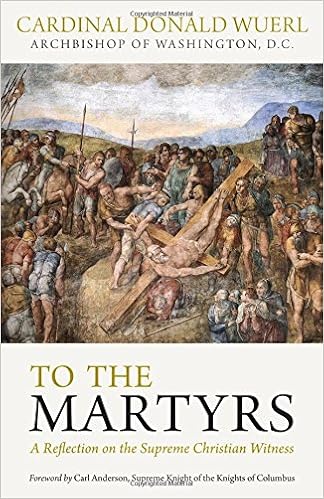
To the Martyrs by Cardinal Wuerl


Cardinal Donald Wuerl, Archbishop of Washington D.C., reflects on the plight and power of the Christian martyrs throughout the Church’s history in To the Martyrs: A Reflection on the Supreme Christian Witness.


Cardinal Wuerl takes us through the pages of Christian history in stages, from St Stephen in the book of Acts to those killed by the Islamic State. He powerfully makes the point that, while the age of martyrs can seem to be long ago and we may think “that can never happen here,” Christian martyrs are making the supreme sacrifice for the faith even today. In fact, being ready to become a martyr is expected of every Christian. 

Cardinal Wuerl describes how the anti-Christian regimes of the past used their power to suppress the faith and how those same methods are being used by governments and regimes in our time. His insight into the past can give hope for the future as Christianity has always outlived those powers.


We are reminded that communion with Jesus Christ is the goal of all who follow Him. Christians accomplish communion by participating in the Eucharist and by emulating ChristThose who are martyred enter into full communion because they emulate Him in suffering and dying as He did. Like Jesus' their deaths are live-giving. This essential tie between the Eucharist and martyrdom is beautifully made.

Another connection Cardinal Wuerl makes is that martyrdom is an unexpected source of unity among Christians.  Those who kill them do not distinguish between denominations or care about doctrinal disputes. The leaders of the Catholic Church and of other Churches find unity when responding to the death of their members.

This book calls all Christians into unity with those who suffer and die for the faith. He challenges us to support them, pray for them and fight for them. We must also pray for their persecutors in the hope of their conversion. Those who receive the Eucharist but do not act in communion with their brothers and sisters participate in the injustice. This reminder of the spiritual battle in which we are engaged is a timely one.

Friday, November 13, 2015

I Have Discerned to Attempt to Write a Book

The last post here mentioned a “project I’m working on”. I have discerned to write a book, or at least attempt to write a book, encompassing the basic theme of this blog (faith & reason). I have a general outline completed and have drafted a few chapters; I’m also working with a proofreader who attends my parish.

There seems to be plenty of apologetics out there already, but I think I can offer a unique twist. When I was trained and certified to teach and use a specific process for problem solving and decision making for my job, I began to see commonalities in thinking between the rational processes I was learning and some of the thinking of the various Catholic philosophers, apologists and theologians I was reading.

If you think about problem solving, it's about finding "truth" objectively, regardless of feelings, strong opinions, past experience or even intuition. This kind of reasoning has helped me to see the clear thinking found in Catholicism and I think I can explain some of these ideas to those who appreciate rational process, but do not appreciate Catholicism or religion in general.
Topics include…
  • How experience and intuitive thinking can sometimes lead us astray, whether dealing with a physical problem or a philosophical problem.
  • How the most reasonable, and therefore, the most responsible conclusions can be determined even when empirical evidence is lacking or impossible to obtain.
  • How the cause of “something” is never “nothing”.
  • Discussion on how the need for objective industry standards demonstrates the need for an objective moral point of reference.
  • How Aquinas regarding contingency relates to Toyota’s 5 whys.
  • The way logic was used by NASA engineers during the Apollo 13 disaster in terms of going wherever the data leads no matter how unbelievable it may seem.
  • ...and much more
I would be targeting someone like I was in my early twenties. Someone born and raised Catholic, received the sacraments, went to RE (or CCD), but had no real connection between faith and everyday life; someone who, if faced with a survey question about religious preference, might struggle between choosing "Catholic" and "None".

Also, targeting those who lead with their head, making decisions about how to live and what to believe more based on certain rationales then based on feelings. Perhaps someone like the man born blind in John chapter nine; someone neither gullible nor cynical; someone who does not jump to conclusions, but who advances cautiously from one step of reasoning to the next with the confidence to admit “…one thing I do know is that I was blind and now I see” (John 9:25).

As consequence of this, I won’t be posting here as often (for now), but wish me luck, or better still, say a prayer. If you have any advice on how to get a book published, I’d love to hear that too!

 
“Yet, my God, my life, my holy joy, what is this that I have said? What can any man say when he speaks of you? But woe to them that keep silence – since even those who say most are dumb.”
– St. Augustine
From Confessions

Thursday, October 15, 2015

Confessions For Today

St Augustine
354 - 430 AD
I was reviewing my notes from Confessions by St. Augustine for another project I’m working on and was once again struck by the personal writing style found in this ancient book. Reading Confessions is like stepping back in time to learn from a master who wants to teach us today, especially when stumbling upon a paragraph like this one from Book 2, Paragraph 2.3.5 (in this edition). “To whom am I narrating this? Not to you, my God, but to my own kind in your presence – to that small part of the human race who may chance to come upon these writings. And to what end? That I and all who read them may understand what depths there are from which we are to cry to you.” Think about it; reading Confessions from A.D. 397 in the year 2015 is like someone reading this post in the year 3633!!!

First a couple of analogies; you may have heard the term “own the language”. When we are discussing the reality of intentionally killing unborn babies, use the language of “choice” to give the illusion of freedom. When discussing abnormal sexual behavior in the context of marriage use the language of “marriage equality” to give the illusion of justice. When discussing torture, use the language of “enhanced interrogation” to give the illusion of legitimate government business. We’ll hear more of this kind of talk as the elections gear-up into 2016. One-upmanship, one-liners and buzzwords can dominate the language.
St. Augustine speaks of language in Book 5, Paragraph 5.5.10. “…because a thing is eloquently expressed it should not be taken to be as necessarily true; nor because it is uttered with stammering lips should it be supposed false.” He goes on to give an analogy using food, where the food is the meaning behind the words and the dishes are the way the words are “served”. Spoiled food can be served on the finest china and wholesome food can be served on tattered paper plates; both kinds can be served on either. Today, “owning the language” mostly relates to serving rancid food on elegant dinner ware.


Another analogy involved drunkenness. We would not comprehend sleep unless we know what it means to be awake. We would not understand darkness unless we have experienced light. In a similar way, we cannot grasp drunkenness unless we are sober. St. Augustine tells us of teachers who are drunk. “I do deplore the wine of error which was poured out to us by teachers already drunk. And, unless we also drank we were beaten, without liberty of appeal to a sober judge” (book 1, par. 1.16.26). Think of today’s dictatorship of relativism. If you have your truth and I have mine, there is no sense in debating about it; might will make right in the end. Obey or be punished. The baker who refuses to bake a cake for a gay wedding will be “beaten, without liberty of appeal to a sober judge”; however, a pro-gun control photographer who refuses to take pictures at a “Sharpshooter of the Year” banquet organized by the local chapter of the NRA just might be shown some mercy.
 

In Book 1, Paragraph 1.5.6 I read something that sounded very familiar, but I could not quite place it. It said “I believe, therefore I speak.” After mulling it over a bit, it hit me as sounding very much like the famous philosophy of “I think, therefore I am.” What St. Augustine said sounds similar, but might as well come from the other side of the universe. “I believe, therefore I speak” acknowledges that the ability to proclaim Truth ultimately comes from something outside of ourselves. “I think, therefore I am” makes the reality of our own being dependent upon our own thinking. This is the rancid food and drunkenness we find ourselves dealing with today.
Read Confessions.