Showing posts with label Reality. Show all posts

Friday, April 15, 2016

Of Restrooms and Reason

Recently, the topics of gender and restrooms came up where I work during some required “diversity training” sponsored by our Human Resources department and the companies’ legal team—I was inclined to call some parts of it the “comply or be punished training”.

There are currently no transgender employees in the building I work in (that I know of), but as a policy our company will allow any such individuals to use whatever restroom they best identify with. One of the presenters said something to the effect of “Just deal with it. You’ll have your own private stall anyway”. I thought, “Why can't the transgender individual just deal with it (“it” being the restroom that best matches their body)? They’ll have their own private stall anyway.”

The situation reminded me of a book called Ten Universal Principals; A Brief Philosophy of the Life Issues by Fr. Robert Spitzer and how the first three principals can be used on just about any topic. Regardless of the situation, some things can be universal to any thinking process and can proceed without invoking any specific belief system. The first three principals are the “Principles of Reason,” and they underscore the universality of rational thought.

The Principle of Non-Contradiction (Plato & Aristotle)
Valid opinions or theories have no internal contradictions.1

If I said I was a married bachelor and we were clear on the meaning of “married” and “bachelor”, then a married bachelor is an internal contradiction. There would be no need for you to investigate my life to see if my claim was true or false. It would be the same situation if I said I could draw a square-shaped circle. If we are clear on the definition of these shapes, then we know that drawing a square-shaped circle is not possible. No further probing required.
So if I’m a man, saying I’m a woman and using the ladies room would enter into the realm of contradiction, right? Not really; if we simply change the definition of gender to exclude (or make subordinate) any physical aspect of the human body, we can avoid this embarrassing conundrum. But don’t definitions need to make sense to be accepted as true? No; consider pro-choice thinking. If we can accept that a person in his or her first stage of life ought to be lawfully referred to as a “non-person”, we’ll accept any incoherency about the human condition.

The Principle of Objective Evidence (Plato & Aristotle)
Non-arbitrary opinions or theories are based upon publicly verifiable evidence.2

Data accessible only to you is subjective. Data accessible to everyone is objective. If I say I’m a man, what objective and publicly verifiable evidence can I show to support my theory? There is genetic data, hormone data, size/shape and also physical body parts that can be publicly verified…hopefully in a way that will not violate public nudity laws. But here again, it comes down to “definitions”. Words are important! Revenant data cannot be sorted from irrelevant data without first defining categories clearly. If gender is defined as primarily existing “between the ears”, then a note from my psychologist saying that I truly believe I’m a woman may suffice to comply with this second principle of reason.

The Principle of Complete Explanation (Socrates, Plato & Aristotle)
The best opinion or theory is the one that explains the most data.3

Are all opinions equally valid? No, some are more valid than others. If my explanation is better than your explanation, it is more valid. Simply put, “better” means being able to explain the most facts using the fewest and simplest assumptions. I would argue that a restroom is a physical place in which we do physical acts, ergo the restroom we choose should best match our physical bodies. If this is coherent, then there should be a certain universality about it. If I go to the gym (physical place) for a workout (physical acts) the equipment I choose should match, or be adjusted to match, my physical body.
Of course, if not for the urinals all the restrooms would be physically the same, but such is not the case where I work and in most places. Even if they were the same or if a person had a full sex-change operation, reflect upon explaining who we are based on whatever we self-identify with in terms of public policy.

The philosophy that says “I think, therefore I am” makes the reality of our being dependent upon our mind. If my mind determines my being, then the old saying follows that “perception is reality”. If this is true, then there should be a certain universality about it. If I think I am a cat, then I am a cat. But who thinks that? Let’s be practical; if a Caucasian man was raised by African Americans in an African American community and he also self-identifies as an African America, then this is the reality. He is an African American and should have access to any and all affirmative action benefits. Agreed?
 
Always remember that perception is not reality; it only informs our response to reality.

In God we trust…all others bring “data”.


1. Fr. Robert J. Spitzer, Ten Universal Principles (San Francisco: Ignatius Press, 2011), p. 11.
2. Spitzer, Ten Universal Principles, p. 14.
3. Spitzer, Ten Universal Principles, p. 9.


Monday, February 23, 2015

Religion & Science ARE Opposed

“Religion and science are opposed . . . but only in the same sense as that in which my thumb and forefinger are opposed - and between the two, one can grasp everything.”
- Sir William Bragg
 
 
Faith & reason together is what helps us to “grasp everything”. Saying “everything” may be akin to saying “all of reality” and we can think of reality as having two parts, material or physical reality and immaterial or spiritual reality.

Physical reality has certain laws like…
  • Laws of motion
  • Laws of matter
  • Laws of energy
These laws are universal and unchangeable. Not knowing, not understanding or ignoring these laws will hurt our bodies. The more we learn about, understand and adapt our life to these laws the more we can live in harmony with the world around us and be happier. In a certain sense we never really break physical laws, they break us!

Spiritual reality has certain laws like…
  • Divine Law
  • Moral Law
  • Natural Law
These laws are universal and unchangeable. Not knowing, not understanding or ignoring these laws will hurt our souls. The more we learn about, understand and adapt our life to these laws the more we can live in harmony with the world around us and be happier. In a certain sense we never really break spiritual laws, they break us!

For the strict materialist, spiritual realities do not exist, at least not like physical laws. Things like morality, justice or goodness can only exist as concepts that evolve over time and different people have different concepts about how the world ought to be. With this logic of moral relativism one cannot grasp the most important parts of reality just like one cannot grasp a football without an opposing thumb. Our concepts of right vs. wrong are tied up in something that ought to be or ought not to be. For that concept to make any sense, you actually need an “ought”!

In a worldview with no spiritual reality, we may say that a group like ISIS has a certain concept of how the world ought to be that is likely different than yours or mine or Mother Teresa’s. Their concept cannot be objectively wrong because there is nothing to make it wrong (no outside system). A compass points north because an outside system (the earth’s magnetic field) makes it point north and there is only one north, not many “norths”. It does not matter what direction a group of travelers believes is north because the magnetic field is completely independent of the minds of the travelers.

What happens if a large group of interdependent travelers refuse to use the compass? They will go “somewhere” based on their beliefs and experience about traveling.  They may split up into smaller groups, but even the smaller groups need to decide what to do. The strongest will rule eventually, whether by physical force or via other kinds of peer-pressure, coaxing or bullying. It’s the same in societies. Even for the most stubborn and independent of individuals, the strongest will rule eventually, whether it’s a dictator by physical force or just a majority via laws and lawyers.

If we convince ourselves that spiritual laws do not really exist, we will live life on our own terms as much as we can get away with. This means we cease to be truly free and alive which is how we “ought” to be. We become small souls, locked in the prison of our ego and victims of a great lie.

 This post started with a notable quote and so it will end with another:
"Growth in faith is growth in the right perception of all reality."
– Thomas Keating


Monday, December 22, 2014

Beware the Boy MOST of All

“This boy is Ignorance. This girl is Want. Beware them both, and all of their degree, but most of all beware this boy, for on his brow I see that written which is Doom…”
- Ghost of Christmas Present

Many of us may reflect on The Christmas Carol this time of year. We are given an ominous warning about “our business”. Mankind is our business, the common welfare, charity, mercy, forbearance and more. We are to help “the girl”, but our doom seems to stem ultimately from “the boy”. Why? Because what we know directs what we do.

If God is Truth, then Truth should direct the will. If love is an act of the will, then to love or judge something, we need to know it. The primacy of the intellect is important in order to love and judge things in the right way. If we are ignorant of what is true, how will we direct our will? What is our criterion for judging, other than our own desires?

Scripture gives us a subtle warning on the topic. “My people are ruined for lack of knowledge!” (Hosea 4:6). If we chose to ignore “the boy”, then doom will engulf us all, because it all starts with ideas, and ideas have consequences. “Sow a thought and you reap an action; sow an act and you reap a habit; sow a habit and you reap a character; sow a character and you reap a destiny.” - Ralph Waldo Emerson

In the 25th chapter of the Gospel of Mathew we hear, “For I was hungry and you gave me food”. This is certainly about physical food, but also about the spiritual work of mercy to feed the intellect. One can think of the truths of our faith as a kind of health-food for the mind.

The seeds of God’s image & likeness are in every person, so we have a natural hunger for truth/knowledge. Stop and contemplate “hunger” for a moment. What happens to people if they are hungry enough, for long enough? They’ll eventually eat something; they’ll eventually eat somewhere, but will it be good food or will it be garbage? Will they care where the food comes from as long as it gives some satisfaction?

The Fall of Man has dimmed the intellect and weakened the will; as a result the human soul easily grows flabby and tired. In other words it is natural for us to be spiritually stupid and lazy. We then default to our animalistic sensibilities and have the habit of replacing God with other masters since it seems to save us so much trouble.

We all like to think of ourselves as independent thinkers, but people are like sheep and everyone eventually sits at the feet of a master. Who will feed our intellect about the right to life, human dignity, the nature of marriage, just war, capital punishment, etc.? Will we sit at the feet of Jesus through His Church or will it be some politician or political party, a celebrity or talk show host, a television evangelist, your favorite college professor, or will it simply be the always "infallible" majority? Who is your master?

Whoever it is, be prepared to give an account for what you believe. “I tell you, on the day of judgment people will render an account for every careless word they speak.” (Mat 12:36)


Saturday, November 29, 2014

DADT Faith

Here is a recent post from The Catholic Thing that fits rather well with the general theme of this blog since we have several posts tagged with both “Reality” and “Professor Ratzinger”.

Burden? Really?
The article is about Cardinal Ratzinger reflecting on some comments made by a nameless colleague of his. The remarks were about being grateful to God that He allows so many unbelievers in “good conscience”. Since many would not be capable of bearing the burden of faith and all its moral obligations, they can still reach salvation going another way, as long as they do it in good conscience.

The comments disturbed the Cardinal and he expressed his dismay in the context of reality. Is no truth better than truth? Should we be grateful for a kind of blindness sent by God for the salvation of souls? In this view, faith is only for the strong. Knowledge would make salvation harder, not easier. The Truth will put you into bondage. Why bother to evangelize? Should we pass this burden on to others? In thinking about WWSD (what would Satan do?), this seems like a very clever and effective strategy for a new anti-evangelization that appeals to human laziness.

I convey this kind of misconception to my Confirmation students by comparing spiritual laws with physical laws. I ask the students if any of them babysit small children. Many respond, “Yes”. I ask if they would let the children play on the roof. They giggle a bit and reply, “No”. I ask, “Why not? The roof is a large open space with many inclines and slants to run up and down on. It would be great fun!”

The students understand the law gravity and how to live in harmony with it; the small children they are responsible for do not. Although small children are perfectly innocent, playing on the roof (even in good conscience) is bad for them and will eventual hurt or even kill them. So, is it best NOT to teach children about the danger of falling? Is learning about gravity only for the “strong”? Does knowledge of physical laws make life harder, like a kind of bondage? Of course not, the more mankind understands physical laws the better our physical life can be.

The same goes for spiritual laws. We are fully alive and most fulfilled when we attune our life and safety around the realities of moral law, natural law and divine law and there is no way to do this if we don’t know what they are. Fornication is a good example to use since most everyone thinks it’s “okay” as long as you “love” each other or perhaps just “lust” each other a whole lot.

The Church teaches that a serious or mortal sin against God’s laws has three conditions (CCC 1857):
  • The object of the sin is of grave matter (sexual sins are always grave since they distort what it means to be made in the image of God).
  • It is committed with full knowledge.
  • It is committed with deliberate consent.
It seems the second point automatically excludes any unchurched non-believer from mortal sin, so shouldn’t we be happy for them? No, we should not. We should be disturbed, as if we saw small children playing on a roof.  The damage being done to their souls will need to be dealt with in this life or the next, just like damage to the body from falling needs to be dealt with, even if one is unaware of the law of gravity.

Is faith a gift from God or a burden? Do we believe it gives rise ultimately to joy, or do we believe what you don’t know won’t hurt you? Do we believe the Truth sets us free or are we living by the “DADT” faith policy? Don’t ask, don’t tell.

Which way?

Sunday, September 7, 2014

Riddle me this...

As you last recall…
We were able to find your age using your cell phone number.

Step 1: Take the last two digits of your cell number
Step 2: ×2
Step 3: +5
Step 4 ×50
Step 5: +1764
Step 6: Subtract your birth year (example:1965)

You will get 4 digits.
  • The first two digits will be the cell numbers.
  • The next two digits will be your age.


How can it be so?
Answer below…


******************************************************************************************************
I found this intriguing when I stumbled upon it since I do some analytical problem solving for a living.  I employed some of the methods we use at work when faced with a perplexing situation. There is also a Faith & Reason connection in here somewhere, so here we go…

1. Identify base premise or premises
For this case:
Your cell phone number and your age correlate. This should NOT be happening!


2. Separate & clarify the situation
Breakdown the situation into specific/actionable elements to minimize/alleviate:
  • Over-generalizations
  • Assumed cause-effect relationships
  • Reality confusion
  • Rationality overloaded by feelings
  • Being overwhelmed by the scope of the problem

3. Make thinking “visible”
Since this is about numbers and variables, knowledge and experience with algebra can be used to simultaneously breakdown the problem and make the thinking visible.

x = last two digits of cell #
y = your birth year
z = your age this year

(2x+5)50 + 1764 - y = 100x + z
100x + 250 + 1764 - y = 100x + z
100x + 2014 - y = 100x + z

 
4. Sort relevant data from irrelevant data
“100x” is irrelevant because they cancel out in the equation above, so "x” is also irrelevant.

We are left with:
2014 - y = z


5. Track assumptions
Is “2014” just the current year used to calculate your age?


6. Verify assumptions
Pretend it's the year 2024 (you are 10 years older) and re-try the riddle. It doesn't work.

 
7. Form conclusions
  • The cell phone number (“x”) is irrelevant data in terms of your age.
            - It can be any number.
            - It is not used to find your age.
            - Your cell number is in the riddle to freak you out.
  • The other numbers are a clever way to get you to calculate the current year (2014).
Call the current year “c”
  • We are left with “c” and “y” as the only relevant data in terms of your age “z”.


c - y = z
or
current year - birth year = age

No concern here.


What kind of faith & reason connection can we make from all this? Perhaps it’s that we cannot reduce the reality around us to only surface observations, or only one way of looking at things. This may not sound very “Catholic” on the surface, but I think it is, as long as we deal with reality in its proper context.

Much in the riddle was invisible to us in the beginning which made it unsettling. It seems your age just “magically” appeared by itself out of some arbitrary numbers and steps, but things became visible with some time, effort and a rational approach that brought clarity and deeper understanding.

Far from being something born of chance, we see that there must have been a mind behind it all, and a very clever mind at that. All I did was discover and sort facts that were already there, and think about what was already thought of before. In the end we found the riddle to be “intelligible”, which ultimately implies “intelligence”. We don’t know how or why the riddler thought of this, but we do know that it requires thinking.

I think the same can be said about the riddle of our “being”, about the course of our lives, about mankind as evolutionary “overkill” (in terms of surviving & reproducing), about how our planet and the entire universe just happened to “magically” appear and “calculate” itself in our favor. Intellectual honesty tells us that it’s all beyond what mindlessness can do. As Albert Einstein once said, “The most incomprehensible thing about our universe is that it is comprehensible”.

Going beyond just deism, when we grow in our catholic faith, we grow in the right perception of all reality, as we say in our creed, of all things visible AND invisible.

“…when we reflect on ourselves as knowers, it is clear that we are pattern-seeking and pattern-loving creatures, creatures curiously made to be curious amidst an order curiously designed to be sought.”

From “A Meaningful World” by Benjamin Wiker & Jonathan Witt


Thursday, April 10, 2014

A Cabin from Nothing

The argument from design can be an intriguing argument for the existence of God, but it’s also an intriguing way to explain unbiased reasoning.

Imagine you were walking in a deep forest with a friend when you both stumbled upon a log cabin. You would naturally assume that something with intelligence created it (presumably a person or a group of people), even if there was no empirical evidence of a builder other than the cabin itself. Unless you had more evidence, you will NOT presume a specific builder by name, but the assumption of intelligence will become a base premise that is non-negotiable.
 
Now suppose your traveling companion said the cabin is just a result of the random forces of nature, matter and energy coming together over time to form the cabin. You would not only disagree, but perhaps also steer your friend toward some psychiatric help. Even if your friend could recite astonishing details about the forces of nature, matter and energy to prove his sanity, you might then conclude that he is so smart, he has become stupid. To accept your friend’s conclusion would be not only unreasonable, but also irresponsible.
  • Now, just begin to increase the physical size of the cabin. Suppose it was the size of a mountain. You would have the same conclusion about “intelligence”. You will not presume the builder must specifically be Paul Bunyan, but the same impartial assumption about an intellect remains.
  • Now, increase the size of the cabin to the size of planet earth…same conclusion about intelligence, although you might drop the part about the source of it being human.
  • Now, keep increasing the size of the cabin to the size of the universe…same conclusion.
  • Now consider our minds, our bodies, our planet and the finely tuned universe we live in that are all much more complex than a log cabin… same conclusion. Intellectual honesty tells us that it’s all beyond what random mindlessness can do for itself.

The science of the past took reason seriously with a premise like this, “We know the creator is intelligent, so we must go forward assuming the universe is intelligible.” This is similar to our approach about the cabin. If you desired to learn more about the construction details, you would do so under the assertion that there is “thinking” behind it all. Today, many hold the backwards, upside down and non-negotiable premise of, “We know the universe is intelligible, so we must go forward assuming there is NO intelligence behind it.”
“It is truly glorious for a religion to have such unreasonable men as enemies.”
- Blaise Pascal

All this might sound very similar to Paley’s watchmaker analogy, which may in turn remind some of the rebuttals offered by philosopher David Hume. For example, very complex self-order is observed in nature regularly, such as the process of snowflake generation from water molecules. This is true, but assuming intelligence behind it is still reasonable. Observing an application running on a computer may give the appearance that the computer is a self-ordered thing, but we know there is a programmer, not to mention a host of other precise, intelligent conditions needed for a computer to run.
Here is another; who designed the designer? If a well-ordered natural world requires a special designer, then this great designer requires an even greater designer and so on and so on ad infinitum. If we can accept a mysteriously self-ordered intelligence as an explanation for the natural world, why not just accept a mysteriously self-ordered natural world by itself?

The problem is the reality we observe in the natural world; the data and the logic. Nothing in the natural world is really self-ordered. The order everything has is contingent upon the order of something else that came before it, until you trace back to some final reality that requires no other condition for its order. Why the need for a final reality? Why not just keep tracing conditions back to infinity? The reason is that an infinite succession of past conditions presents us with a contradiction.
  • Premise #1:Infinity as applied to an accumulating succession is always more than can be ever achieved. It is unachievable.
  • Premise #2: For something to exists, all the conditions needed for its existence must be achieved.
  • Conclusion: Anything that exists cannot come from an infinite succession of conditions because it would depend upon an unachievable number of past conditions being fulfilled. To say it can is like saying the unachievable has been achieved, which is a contradiction. This is true for an infinite succession of intelligent designers as much as anything else.
(see formal proof for an unconditioned reality).

An unconditioned intelligent “something” that transcends the natural world is the reasonable and responsible position to hold using reason alone, and we would all do well to ponder what a curious “something” that would be. Nothing in this post definitively proves all the Catholic theology there is about God, but to say the universe and everything in it, from the stars in the sky to the love in your heart, is a mindless accident that magically happens by itself is truly wishful thinking for the non-believer who wishes to avoid the reality of things. In terms of believing in fairytales, never was the shoe so firmly on the other foot.
“Man does not explain himself to himself without the odd suspicion that he is missing something.”
 - James V. Schall, S.J.


Friday, April 4, 2014

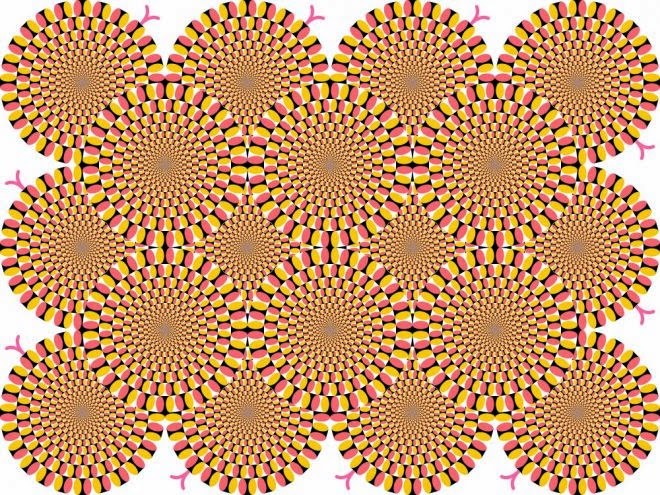
Illusion of the Day

This is not a GIF file. Nothing is moving. The more your eyes wander, the worse it gets. Remain calm! It helps to keep your eyes focused on one point; then everything starts to slow down.

NOTE: The illusion may not be so effective on a small screen like on a smart phone.

Rotating Snakes Illusion by Kitaoka Akiyoshi
The graphic is called "rotating snakes" and it can be a symbol for the spiritual life. Note the snake-like tongues. How well does Lucifer keep us distracted (fools us) with things that are NOT real. Stay focused on one point, the light of Christ, and see the reality that does not change.

There's a Faith & Reason lesson in there somewhere; I know it.

• Don’t always trust what you see… Yes, but more than that.

• Perception is not reality. Perception informs your response to reality… That’s better.

• Growth in faith is growth in the right perception of all reality… THAT'S IT!!!
- Thomas Keating

THAT'S IT!!!
See also “The Medieval Wheel of Fortune” post as it also relates to a focus point via a Christ centered life.

Monday, March 10, 2014

The De-Evolution of Thinking with Stanford Nutting

The last post on this blog included the photo below. I had also posted it on Google+ with a simple caption that read, “Although a lot could be said about this, I think the photo says it all.”
Kevin O'Brien as Stanford Nutting

I was surprised at some of the comments it received. Here were some thoughts from myself and a couple of acquaintances from Google+.
The Sweater
Perhaps a throwback to what a 1970’s CCD teacher might wear, or perhaps it stands for the square of truth you decide to take while choosing not to believe the other truths. Pick a color! Of course, we must be inclusive and accept every version of truth, so that all the colors of our world can come together like one giant ugly sweater. The sweater seems unified, but note the black chasm between each color.

1. What is “Truth”?
This is about questioning absolute Truth. It could be asked sarcastically, but many will sincerely contemplate this, really seeking what is true in terms of things like morality, justice, goodness, love, etc. Or perhaps seeking to answer what the nature of Truth is, rather than a particular truth of a particular matter. In this context, one can understand Pontius Pilate's identical question in the gospel of John 18:38, and of course the answer is a concrete one, Jesus Christ, the man standing before him.
2. What is?
Could this be a “fill in the blank” or just the beginning of whole new level of bewilderment? This question seems to no longer be asking about truth at all, but asking about existence. What IS? What exists? What is anything? But, if we go by the suggestion of the conclusion of the first question, we might say it more properly as "Who is?", and then we end up with God, the one whose name is "I AM", the one who “IS”, existence itself.
 
3. What?
One is confused or maybe surprised, but perhaps still searching coherently to some extent. The question is simply "What?" This is a common way of expressing concern, astonishment or mishearing, an attempt to confirm what has already been said. It is clear that something of significance has been mentioned in the two questions above, but comprehension has not been reached, so it needs repeating or perhaps just leaves one in shock

4. Wha?
One is now deep into the muddle. The question is no longer coherent; it remains unfinished. Imagine you walk into a room and say “Wha?” You realize something strange is going on in the room and say “never mind, I don't want to get involved".  Upon further examination of the previous questions, the answers are too large or out of reach, and one is left feeling both confused and maybe slightly stupid or in a state of extreme disbelief.

5. ?
Now there are no words at all, which means there is no more dialogue. If there is no more dialogue, we end up with the dictatorship of relativism. If you have your truth and I have mine, there is no point in even discussing any of the above. In this scenario, might makes right; you will agree or be punished. The purpose of life and the nature of man are lost in a fog, but there might be two paths forward…seek or despair.

One can desperately and blindly continue into the fog, or perhaps “?” can trigger a humble state. One is at a loss for words, a state of unknowing, not even knowing what to ask. One has encountered something so foreign that it is impossible to even guess at anything that would shed light on it. As if a stranger started speaking in a foreign language, you have no clue as to what is going on. This could trigger a proper state in which to receive God’s grace. There are no further questions, but one is open to the answers or instructions that may come. Assumptions are dropped, and one waits for whatever is given. Perhaps the awe of the Lord as a gift of the Holy Spirit is soon to follow this kind of “?”.

These are just some ideas as to the meaning of each question. What do you think? We know you’re out there.
WHAT SAY YOU???

Wednesday, January 15, 2014

Why Attend Mass?

Perhaps you have a friend or relative that rarely attends Mass, but did attend at Christmas. Perhaps you asked, or at least thought, “Why you don’t come next week and the week after?” If you were so bold as to invite them back as a kind of New Year’s resolution, you may have received a polite, “we’ll see” in response, which is often translated as “of course not”.
 
If you persist, you’ll eventually enter a realm the separates man from beast, the realm of the intellect, the desire to know “why”. A Catholic that “believes” to some extent will eventually ask why, even if only asking the question internally. Attending Mass is nice, but why necessary? God is everywhere, why can’t I be left alone to worship in my own way? Replying back that it is an obligation or a precept of the Church tends not to satisfy. Mentioning the violation of the first and third commandments may get more attention, but can still be seen as “finger wagging”. You’d do better noting that if the first is followed, abiding to the third will come naturally.


Another tactic came about for me and my wife as we became involved with the marriage ministry at our parish. One of the things we do is to meet with engaged couples in our home to review the results of their FOCCUS questionnaire. It covers many practical topics of compatibility including finances, communication, extended family issues, sexuality issues, etc. It’s a tool to help couples work through issues before marriage.

Of course, there are religious topics as well and the topics of marriage covenant and religion can be quite awkward when speaking with interfaith couples or catholic couples in which one or both are nominal in their faith. It’s not uncommon for us to dialog with couples in which one or both rarely attend Mass (if ever), and yet they still see it as important to be married in the Catholic Church (thankfully).

The following three areas of reasoning help to satisfy their intellect, at least to some extent. Since what you know will influence what you do, these thoughts just might help you tip the scales in getting someone to Mass. As Pope Francis is actively showing us, we need to meet people where they are at without denying the reality of where they are.

In Terms of Relationship:
It’s especially easy to draw this analogy when dealing with couples in love. Imagine you were married and you spent about one hour at Christmas and one hour at Easter with your spouse with no other interaction throughout the year. What kind of relationship would that be? Suppose it was one hour per month? That’s better, but still lacking. Even if it were once per week for about one hour, we might consider it a working relationship, albeit a weak one.

God desires a close relationship with us and all close relationships require time and commitment. How would you feel if your beloved thought that one hour per week with you is too much trouble?

In Terms of Reality:
The above might be easily refuted by saying, “I pray in my own way all the time. No need to sit in a church building. The man upstairs and I have an understanding.” This is when the imagination must be put firmly in its place with a reality check.


We can think of all reality as being made up of two parts; physical realities and spiritual realities. Think of your physical life. To be a physically functioning human being there are times when you must function alone, like getting dressed for the day, or perhaps you sometimes work alone or maybe you live alone. There are also times when you must function with others, like with family, co-workers, community members, etc. We’re social beings; it’s how God made us.

This parallels our spiritual life. To be a spiritually functioning human being there are times when you must function alone, like personal prayer and spiritual study. There are also times when you must function with others, like community worship (Catholics call this Mass). Once again, we’re social beings; it’s how God made us.

Last, but certainly not least…In Terms of the Eucharist:
This goes beyond community worship; it’s the source and summit of the faith. If the body and blood of Christ is given to us a spiritual food, it stands to reason that this is the most intimate thing God can possibly give to a human being still on earth.

So, the God of the universe wants this extreme level of intimacy with us and our response is…
- Too tried
Thou shalt NOT
have better things to do!
- Too busy
- No time
- Don’t feel like it
- I have better things to do

Think of how offensive this apathetic attitude must be to God? In this context, it seems more than appropriate to refer to skipping Mass as “grave matter”.

If the truth about relationships, the social & spiritual nature of man and the Eucharist really sink in, one’s perspective about attending Mass can change from a pessimistic, "I've got to do this?" to an enthusiastic, "I get to do this!” and it may even turn out that once per week is simply not enough!

“If we attend Mass well, surely we are likely to think about our Lord during the rest of the day, wanting to be always in his presence, ready to work as he worked and love as he loved”
- Josemaria Escriva, Christ is Passing by