Wednesday, May 28, 2014

The Maniac

G.K. Chesterton would have been 140 years old on May 29. Although he passed on a bit short of that mark (June 14, 1936), even the most resolute atheist would admit that he lives on through all his writings. There are quite a few things lurking in this blog inspired by Chesterton. Sadly, I’ve only read one of his books from cover to cover (so far), but it’s a classic; it’s Orthodoxy.

Orthodoxy means “right teaching”, which is the opposite of what we have today where we act as if there is no “right” and no “teaching”, but we do find plenty of heresy or heterodoxy, which means “other teaching”. Chapter II of Orthodoxy is entitled The Maniac and it begins with a popular other teaching we often hear today. It’s the individualistic philosophy that a person will get along fine in life if he just believes in himself. There is nothing wrong with self-confidence, but could we not write “He Believed in Himself” over the grave of every famous tyrant in history? Could we not find criminals, oppressors and terrorists today who believe in themselves? Could we not find people in insane asylums who believe in themselves?


Anyone can believe in himself, and in a culture that denies objective truth all opinions become equally valid, even the opinion of a maniac. In this environment basic terms cannot be defined because the definitions are relative, and having well defined terms is a first step in logic. So reasoning with a maniac about what “believe in yourself” really means can be the catalyst for an endless game of “point-counterpoint”.

“A madman is not someone who has lost his reason but someone who has lost everything but his reason”
 – G.K. Chesterton
 
Examples:
  • If you have children you may be familiar with “point-counterpoint”. Once, my son was bothering my oldest daughter by touching her. I said, “Stop touching her.” He said, “I did not touch her.” I replied, “I just saw you!” He said, “I touched her shirt, not her.” Of course, my daughter just happened to be wearing the shirt he was touching. From here we could have gotten into an insane discussion (or demonstration) about what would constitute touching someone, but I wasn’t in the mood for games.
  • This need not be only a game for children. I’m reminded of the trouble former President Bill Clinton got into in the late 90’s with a certain female intern which caused him to say, "It depends on what the meaning of the word 'is' is."
  • One might think it easy to be clear about such simple words as “touching” and “is”, but maniacs can be great reasoners. Imagine someone suffering from paranoia says to you, “Everyone wants to kill me.” You respond, “I don’t want to kill you." The person answers, “Of course you would say that to keep your evil plan a secret.” There is logic there. The explanation covers the facts.

“If you argue with a madman, it is extremely probable that you will get the worst of it; for in many ways his mind moves all the quicker for not being delayed by the things that go with good judgment.”
G.K. Chesterton
 
The above examples may seem humorous, but the consequences are no laughing matter when the maniac engages the very basics of life, family and what it means to be human. When does human life begin? Both science and faith point to the moment of conception, but the maniac will look elsewhere. What is marriage? Whatever we want it to be? If it can mean anything, then it means nothing, so we demand some kind of definition via laws and definitions always require limits. How do we know if the limits are right or wrong? Cultural consensus becomes the infallible guarantee that all is well with whatever opinion the majority has. The underlying problem is that we demand laws, limits and morals without God. It’s like demanding electricity and then denying the existence of a generator.
 
A clever analogy between the sun and the moon was given at the end of the chapter to compare reason grounded in God (orthodoxy) vs. reason grounded in man (heterodoxy). God is our ultimate source of reason just like the sun is our ultimate source of energy. The sun provides both light and heat, but it is impossible to look at it directly. We call its shape round, but as we wince at it and try to trace out its exact shape with our eyes, we can’t do it. It’s too much for us. It’s both shining and shapeless. Like a mystery, we can’t define it perfectly.
 
Whatever light we receive from the moon is secondary light that ultimately comes from the sun, although one might think at first glance that moonlight has nothing to do with sunlight. The moon reflects light off of a dead world and gives no warmth, but at the same time the moon is quite reasonable. Its circular shape is clear and unmistakable.
 
“The moon is the mother of lunatics and has given to them all her name.”
– G.K. Chesterton
 
So how can one finally reason with the maniac? Other than presenting orthodoxy and insisting upon well-defined terms and premises (both stated & assumed), I really don’t know. At times it seems to be more about casting out demons than debating philosophies and facts. As far as a final solution, I’ll need to think about it and get back to you.

I’ll just sit here until I figure all this out.


Friday, May 16, 2014

What's in 100,000 Digital Touches?

We finally reached 100,000 hits or “digital touches” as we like to say. Of course, some blogs may do this in one day for all we know, and some hits are spam or just the two of us clicking around the blog. So what’s the big deal?

Well, I would think 100,000 hits represent at least a few hundred different people reading about Catholic Faith & Reason and that’s no small thing. Regardless of the real numbers, this blog has always been a place where two or more are gathered, so thanks for caring and thanks for sharing.

Here’s a little more about us:
The Two Catholic Men are fellow parishioners, neighbors and good friends like this…


We are studious like this…


Loyal to the Church like this…
 

We “assist” misguided blog commenters like this…
Joe & Ben vs. random "wrong-person"
 
Sometimes stubborn like this…


Anti-Catholics find us curiously disturbing like this…
 

That’s OK; we find them curiously disturbing like this…
 

…yet we maintain a joyful worldview like this...


Last, but certainly not least, we’re grateful to God like this…
Thanks for visiting!!!
 

Monday, May 5, 2014

What do you mean by...?

One of the first steps of a problem solving process is to be clear on meaning. If one were to say X is not working right or Y is acting funny, the specific meaning of “not working right” or “acting funny” must be separated and clarified. We separate to see if there is actually more than one issue being lumped together as if it were one, and we clarify to get the most specific meaning possible.

This requires a dynamic back and forth communication between the information source (the person with the problem) and the information gatherer (problem solver). A one-time static communication almost never works out well. This kind of thing was demonstrated very well by apologist Patrick Madrid in a Lighthouse Catholic Media CD using what appears to be a very straight forward and simple sentence. Consider the statement, “I didn’t say you stole the money.” It seems clear enough. What could possibly be misinterpreted about it?

  • Suppose we put the emphasis on the word “I” so we have “I didn’t say you stole the money”. This could mean that I am not accusing you, but someone else is.
  • Now put the emphasis on the word “you” and we have “I didn’t say YOU stole the money”. This could mean that I am not saying you did it, but I am saying someone else did.
  • Put the emphasis on the word “stole” and we have “I didn’t say you STOLE the money”. This could mean that I am not saying you stole it, but I am saying you did something else with it, like wasted it.
  • Put the emphasis on the word “money” and we have “I didn’t say you stole the MONEY”. This could mean that I am not saying you stole money, but I am saying you stole something else.
If you were not present to hear the emphasis on any particular word or to ask some clarifying questions, the true meaning of the statement would be lost. The same can be true of the statements found in the Bible. How do we know we have it right when we can’t go back in time and ask the author, “What do you mean by…?”

Consider a simple word like “believe” in the famous verse… “For God so loved the world that he gave his only Son, so that everyone who believes in him might not perish but might have eternal life” (John 3:16). It goes on in verse 18… “Whoever believes in him will not be condemned, but whoever does not believe has already been condemned, because he has not believed in the name of the only Son of God.” A verse from today's gospel is not as famous, but just as relevant.Jesus answered and said to them, ‘This is the work of God, that you believe in the one he sent.’” (John 6:29).

 
So what does it mean to believe? It would seem that we need to be very clear about the precise meaning of this word. Is it just an intellectual or factual belief, like believing the earth is round or believing that two and two make four? James 2:19 says “You believe that God is one. You do well. Even the demons believe that and tremble.” So if the demons can believe, should we believe the same way they do?
 
Other verses seem to clearly link our belief to what we do, like in James 2:20-26. These verses link what Abraham did, in offering up his son, to his belief in God (see also Romans 4:3 & Gal 3:6)

Sometimes it is helpful to think of opposites when trying to understand something. If we need to better understand the color white, it helps to study the color black. If we find out that black is the absence of visible light, it helps us to understand how white contains all the wavelengths of visible light at equal intensity. What would be the opposite of belief? Disbelief? John 3:36 suggests that disobedience is the opposite of belief, “Whoever believes in the Son has eternal life, but whoever disobeys the Son will not see life, but the wrath of God remains upon him.” Again, our belief seems to be linked to what we do, or don’t do, as opposed to merely agreeing to some concept intellectually.

This is not meant to be a biblical study on the concept of Christian Justification, but just an illustration of how static words on a page are subject to human interpretation. When our nation’s founding fathers wrote the Constitution, why did they bother to form a Supreme Court to interpret the Constitution? Did they not understand what they were writing? Did they not know how to express themselves? Could not future generations just read the words and understand what to believe and what to do in terms of governing a nation?

One can argue that the Bible is the living Word of God, not dead words on paper, and the true believer is guided by the Holy Spirit to the correct interpretation. In this case, all the disagreements among Christians and all the different denominations can be explained by people not listening to or misinterpreting the Holy Spirit. Of course this begs the question, who should I listen to if I cannot question the Holy Spirit directly? I’m afraid the answer in many cases becomes “Whoever agrees with me” and thus we make ourselves God. This is why Jesus founded a Church, not a book. We could all take a lesson in humility from an Ethiopian eunuch who lived long ago. He got it!

“Philip ran up and heard him reading Isaiah the prophet and said, ‘Do you understand what you are reading?’ He replied, ‘How can I, unless someone instructs me?’” (Acts 8:30-31)


Tuesday, April 22, 2014

Got Just 3 Words for You

There is much talk about Jesus during Holy week and the Easter season that follows, even from secular sources. All the homilies & sermons, all the writings & scripture and even all the movies & television shows about Jesus can be distilled down into three basic elements expressed by these words – Way, Truth and Life, and these three words describe what mankind has lost just as precisely as a key fits a lock.


A most curious point is how Jesus describes himself as the way, the truth and the life using the curious phrase “I am”. If someone were to say I have or I know the way, the truth and the life, we must study what they have or what they know if we want to obtain it. Who that person actually is would be of secondary importance if any importance at all. Consider an ordinary teacher; the knowledge he or she is trying to covey in class is our primary concern. The person teaching is not the focus and a substitute teacher is possible to find. If someone were to say, however, I am the way, the truth and the life, then we must study who that person IS. “I am” relates to “who” as knowing or having relates to “what”. Christ does not simply give us the way, the truth and the life and then leave us to follow as best we can. He gives us Himself, for He is all three and there is no substitute.

WAY:
There is a problem. The way is closed. There is a chasm. We live in a fallen world. We cannot see God face to face as we are. Jesus is the bridge that reaches across the chasm between God and man. Think of the way as a road to salvation that was closed, but is now open for everyone to travel on. Of course, if one holds that there is no way or the way it is not relevant, then for them, it is as if the way were still closed.

TRUTH:
Once the way is open, how do we navigate it? Once a road is open we don’t just wander around it like lost sheep hoping to get somewhere eventually. A road always has a direction and a way of traveling upon it. There are lines and boundaries; there are signs and lights to obey. There are other travelers to consider. We cannot understand the road if we do not understand the rules of the road. We need truth to guide us on the journey. So how can we know the truth as we travel? How about the Bible? That’s a good start, but not a good end. The Bible will ultimately point to something else. “…the household of God, which is the church of the living God, the pillar and foundation of truth.” (1 Tim 3:15) Of course this begs the question “Which church?”, since there are so many and they all have different road rules, but this is a question for other posts. See HERE and HERE.

LIFE:
If Jesus is the life, and we wish to live, then He must live in us. The strength of man alone is not enough to walk the way. Imagine you were to travel to Mars just as you are. Not only would you never be able to live on Mars, but you would not even survive the journey. The long journey to Mars would require many special systems, equipment & supplies to sustain your physical life. In the same way our souls cannot travel back to God unaided. We need a supernatural life.
 
  • Baptism is the birth or beginning point of the supernatural life.
  • We can receive daily nourishment for the journey via the Eucharist, which is none other than the Lord himself as our food.
  • Just like the body needs healing from sickness & injury on a long and difficult journey, our souls need healing from sin on our supernatural journey, so the Lord gives us the sacrament of Reconciliation.
  • The Journey is long. We need to grow and mature while we travel, so we are equipped with the Grace given at Confirmation.
  • As we grow and mature in our supernatural life, we are responsible to help others along on this challenging voyage. Our vocation helps us to advance the entire Kingdom of God forward.
  • There is even a special Grace near the end of our journey to help us finish well. The anointing of the Sick.

 “In three words Way, Truth, Life, Our Lord sums up what He is. In the same three words we may summarize what He did. He opened to men the way of salvation, gave them the truth by which that might know the way, and the life by which they might travel it.”
- Frank Sheed from Theology and Sanity.

Much in this post was inspired by lay apologist Frank Sheed. We all need some Sheed!!

Frank Sheed 1897 - 1982
 

Thursday, April 10, 2014

A Cabin from Nothing

The argument from design can be an intriguing argument for the existence of God, but it’s also an intriguing way to explain unbiased reasoning.

Imagine you were walking in a deep forest with a friend when you both stumbled upon a log cabin. You would naturally assume that something with intelligence created it (presumably a person or a group of people), even if there was no empirical evidence of a builder other than the cabin itself. Unless you had more evidence, you will NOT presume a specific builder by name, but the assumption of intelligence will become a base premise that is non-negotiable.
 
Now suppose your traveling companion said the cabin is just a result of the random forces of nature, matter and energy coming together over time to form the cabin. You would not only disagree, but perhaps also steer your friend toward some psychiatric help. Even if your friend could recite astonishing details about the forces of nature, matter and energy to prove his sanity, you might then conclude that he is so smart, he has become stupid. To accept your friend’s conclusion would be not only unreasonable, but also irresponsible.
  • Now, just begin to increase the physical size of the cabin. Suppose it was the size of a mountain. You would have the same conclusion about “intelligence”. You will not presume the builder must specifically be Paul Bunyan, but the same impartial assumption about an intellect remains.
  • Now, increase the size of the cabin to the size of planet earth…same conclusion about intelligence, although you might drop the part about the source of it being human.
  • Now, keep increasing the size of the cabin to the size of the universe…same conclusion.
  • Now consider our minds, our bodies, our planet and the finely tuned universe we live in that are all much more complex than a log cabin… same conclusion. Intellectual honesty tells us that it’s all beyond what random mindlessness can do for itself.

The science of the past took reason seriously with a premise like this, “We know the creator is intelligent, so we must go forward assuming the universe is intelligible.” This is similar to our approach about the cabin. If you desired to learn more about the construction details, you would do so under the assertion that there is “thinking” behind it all. Today, many hold the backwards, upside down and non-negotiable premise of, “We know the universe is intelligible, so we must go forward assuming there is NO intelligence behind it.”
“It is truly glorious for a religion to have such unreasonable men as enemies.”
- Blaise Pascal

All this might sound very similar to Paley’s watchmaker analogy, which may in turn remind some of the rebuttals offered by philosopher David Hume. For example, very complex self-order is observed in nature regularly, such as the process of snowflake generation from water molecules. This is true, but assuming intelligence behind it is still reasonable. Observing an application running on a computer may give the appearance that the computer is a self-ordered thing, but we know there is a programmer, not to mention a host of other precise, intelligent conditions needed for a computer to run.
Here is another; who designed the designer? If a well-ordered natural world requires a special designer, then this great designer requires an even greater designer and so on and so on ad infinitum. If we can accept a mysteriously self-ordered intelligence as an explanation for the natural world, why not just accept a mysteriously self-ordered natural world by itself?

The problem is the reality we observe in the natural world; the data and the logic. Nothing in the natural world is really self-ordered. The order everything has is contingent upon the order of something else that came before it, until you trace back to some final reality that requires no other condition for its order. Why the need for a final reality? Why not just keep tracing conditions back to infinity? The reason is that an infinite succession of past conditions presents us with a contradiction.
  • Premise #1:Infinity as applied to an accumulating succession is always more than can be ever achieved. It is unachievable.
  • Premise #2: For something to exists, all the conditions needed for its existence must be achieved.
  • Conclusion: Anything that exists cannot come from an infinite succession of conditions because it would depend upon an unachievable number of past conditions being fulfilled. To say it can is like saying the unachievable has been achieved, which is a contradiction. This is true for an infinite succession of intelligent designers as much as anything else.
(see formal proof for an unconditioned reality).

An unconditioned intelligent “something” that transcends the natural world is the reasonable and responsible position to hold using reason alone, and we would all do well to ponder what a curious “something” that would be. Nothing in this post definitively proves all the Catholic theology there is about God, but to say the universe and everything in it, from the stars in the sky to the love in your heart, is a mindless accident that magically happens by itself is truly wishful thinking for the non-believer who wishes to avoid the reality of things. In terms of believing in fairytales, never was the shoe so firmly on the other foot.
“Man does not explain himself to himself without the odd suspicion that he is missing something.”
 - James V. Schall, S.J.


Friday, April 4, 2014

Illusion of the Day

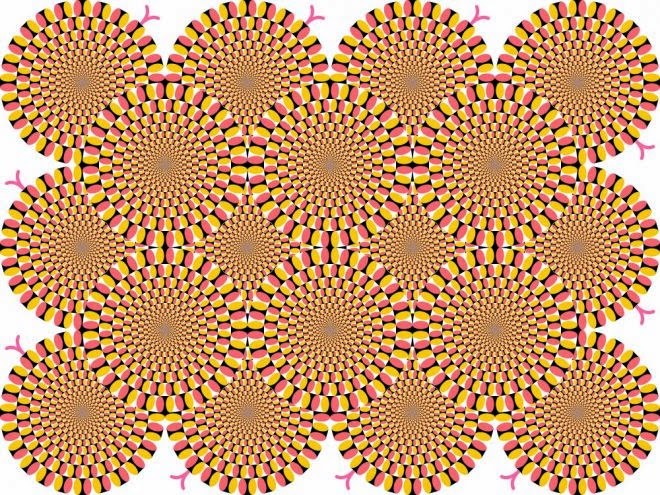
This is not a GIF file. Nothing is moving. The more your eyes wander, the worse it gets. Remain calm! It helps to keep your eyes focused on one point; then everything starts to slow down.

NOTE: The illusion may not be so effective on a small screen like on a smart phone.

Rotating Snakes Illusion by Kitaoka Akiyoshi
The graphic is called "rotating snakes" and it can be a symbol for the spiritual life. Note the snake-like tongues. How well does Lucifer keep us distracted (fools us) with things that are NOT real. Stay focused on one point, the light of Christ, and see the reality that does not change.

There's a Faith & Reason lesson in there somewhere; I know it.

• Don’t always trust what you see… Yes, but more than that.

• Perception is not reality. Perception informs your response to reality… That’s better.

• Growth in faith is growth in the right perception of all reality… THAT'S IT!!!
- Thomas Keating

THAT'S IT!!!
See also “The Medieval Wheel of Fortune” post as it also relates to a focus point via a Christ centered life.

Tuesday, April 1, 2014

Joke of the Day


Not to confuse or offend anyone, but this is fun. An evangelization technique like this would only make sense on a day like today…


One of the great things about being Catholic is that not only do we get to worship statues, but even our statues get to worship statues!!!

April Fools'!