Showing posts with label "book review". Show all posts

Monday, May 15, 2017

Imprimatur Granted!


Good news! My book, Faith with Good Reason, recently received an imprimatur (or permission to publish) from our local bishop. A book imprimatur in the Catholic Church is not an endorsement, but an acceptance or guarantee that something is of a good standard, free of any moral or doctrinal error. I'll be working with the publisher to have the proper verbiage printed in the book.


Comment from the reviewing theologian…
"Excellent work! I really enjoyed the book. You have a gift for explaining ancient teaching with modern lingo and examples that lose none of the depth of the teaching."

I'll now have more confidence proposing the book and concept to Catholic organizations, book sellers, schools, etc. The concept itself is age-old in terms of Faith & Reason, but I added what I feel is a unique twist that relates our Catholic faith to elements of analytical problem solving and decision making.

Problem solving seeks to answer the question “Why did it happen?” Decision making seeks to answer “What should we do?” This relates strongly to how we think (the intellect) and what we do (the will). Why do people firmly believe things they can’t prove? For example, does the Earth really revolve around the Sun? Have you seen it? Have you measured it? Or do you firmly believe it because it’s what other people told you?

Since what we think ultimately directs what we do, it's imperative that we study what we think and why we think it. Faith with Good Reason attempts to do just that and to do it for what is mentioned in the Catholic Creed, which is no less than…“all things visible and invisible”.

Please enjoy Faith with Good Reason now available at all these on-line book sellers:


Friday, September 23, 2016

My Book is Now Available!

Buy the book based on the blog!!! It’s Faith with Good Reason and it’s now available on Amazon Books. CLICK HERE!

I’m pleased that the release date is September 23, the feast day of St Pio of Pietrelcina. In case you are not familiar, St. Pio was a Capuchin Friar in Italy that had the stigmata. The wounds of Christ were on his body for 50 years. He died in 1968, so this is not something far removed from our own day and age. When I was a teen, I saw a secular documentary about St. Pio (then Padre Pio) and it was the first time I saw religion as not just "talk"; there was something physical happening and it stuck in the back of my mind. It was the first time I saw a clear connection between physical reality and spiritual reality—the visible and the invisible—which has a lot to do with the book.

Book Description:
“This book is a practical look at faith, reason and problem solving for dealing with the common realities we face, navigating the gaps between what we know and what we don’t—for all things visible and invisible. Thinking means linking ideas. Analytical problem solving is about finding “truth” objectively, regardless of feelings, strong opinions, past experiences or intuition; finding truth even when empirical evidence is lacking or impossible to obtain. No one sees reality in its entirety, yet people firmly believe things they can’t prove. We use base premises to judge things, whether consciously or subconsciously. Like any good problem solving situation, it’s important to drill down to the base premises of our thinking and then ascertain where they come from and how reasonable they are when pressed under deliberate questioning.”

It’s ideal for those who…
  • Appreciate rational thinking, but do not appreciate Catholicism or religion in general.
  • Were baptized and raised Catholic, but had no real connection between faith and everyday life.
  • Might struggle between choosing “Catholic” and “none” when faced with a survey question about religious preference
  • Lead with their head, making reasonable and responsible decisions about how to live and what to believe based on certain rationales rather than emotion.
  • Are neither gullible nor cynical.
  • Do not jump to conclusions, but advance cautiously from one step of reasoning to the next.
Foreword written by Stacy A. Trasancos, PhD. Author of Particles of Faith: A Catholic Guide to Navigating Science & Science Was Born of Christianity: The Teaching of Fr. Stanley L. Jaki; also, professor of Science in the Light of Faith at Holy Apostles College & Seminary.


INTERESTING SIDE NOTE:
A significant amount of the royalties will be donated to these fine gentlemen in the mountains of Wyoming to help build their new monastery.


Enjoy Faith with Good Reason!!!

Saturday, September 10, 2016

Contemplating the Particles of Faith

I recently had the opportunity to review a new book before its release. The book is called Particles of Faith by Stacy A. Trasancos; it’s an ideal stocking stuffer (and it’s not too early to think about stocking stuffers) for the college student who just left home for the very first time to study the sciences, and perhaps, stopped going to church for the very first time as well. Many struggle with how to reconcile faith and science. This book will show you how science can only be properly understood in the light of faith.

The author is a Catholic scientist herself, so who better to write on the topic. Read it and learn all about…

  • The chasm that faces every scientist
  • How scientists know very much about very little
  • The “System of Wills” and the interlocking system of reality
  • The Battleship of Scientism: Can you trust a ship that does not know where it is going or where it came from?
  • How the story of evolution is itself evolving
  • How to answer that question that annoys so many, especially in a big election year. “When does human life begin?”
  • How leaves on a tree, flapping mindlessly in the wind, helped bring a scientist to faith
This book reminded me a lot of something mentioned a few times on this blog called “The Weak Eye”1. It’s an allegory I often elaborate on from lay apologist Frank Sheed. It goes like this…

We have two physical eyes. There are also “two eyes” when looking at life; a secular eye and a spiritual eye. Our secular eye can refer to not only our bodily senses, but also all the practical things we study and learn about to help us function in our communities, homes, and jobs. This would include all the sciences as well. The spiritual eye is about how we all ponder things like the Good, the Beautiful, the True and the meaning behind it all. This eye is focused on spiritual reality. Many Catholics end up with a weak spiritual eye simply because they don’t know or exercise their faith.

What happens if we have one weak eye? There is lack of focus; we cannot see reality clearly. This can explain how those who are highly trained and educated in science can lack spiritual common sense. We can even be educated out of our faith as the secular eye gets stronger and stronger, while the spiritual eye is ignored and grows weaker and weaker. No exercise.

Once we find that reality seems unclear, what can we do? We can either close the weak eye and forget it entirely or exercise it and build its strength. But how? Think of a child that has a condition sometimes called “lazy eye”2. A doctor might recommend a way for the weak eye to start working harder. If this isn’t done, there is a good chance one eye will always be weaker than the other eye. As a result, the brain favors the stronger eye. The weaker eye tends to wander. Eventually, the brain may ignore the signals received from the weaker eye. One eye will always be blurry, one always sharp.

It’s the same thing in the spiritual life as the author alludes to in her book. She began to follow what the Church teaches (as an act of the will) by attending Mass, praying daily, consciously pursuing virtue and avoiding sin, all of which gave her spiritual eye the opportunity for exercise. If we don’t do these things, we will always favor the secular eye due to poor vision in the other spiritual eye. The weaker eye will tend to wander (spiritual wandering). Eventually, you may ignore the signals received from the weaker eye. One eye will always be blurry, one always sharp. “Whoever has ears ought to hear.” (Mt 13:9)

In terms of proof, the author tested the principles of the faith in the laboratory of her life and found them to be true, but in the end aren’t all proofs like a glass of water?

“You can purify that water and set it down in all the fine crystal you want, but you cannot force a person to drink it.”
—Stacy Transancos
Particles of Faith, page 69

Released date Oct. 10th

1.     Frank Sheed, Theology for Beginners (Cincinnati: Servant Books, 1981) p. 185.

2.     Mayo Clinic Staff, Mayo Clinic [Website], “Diseases and Conditions Lazy eye (amblyopia) Definition” (3 July 2013), Site address: http://www.mayoclinic.org/diseases-conditions/lazy-eye/basics/definition/con-20029771

Monday, August 15, 2016

4 Big Bangs?

I’m currently reading a series of e-books by Robert Kurland, physicist and blogger at Reflections of a Catholic Scientist. The latest installment, Science Verses the Church, starts with “ways of knowing” and the limits of science, and continues on with a brief history of the Church and science and then into topics of cosmology, anthropology, evolution and much more. Each topic is presented with a plethora of perspectives from differing scientist, including the author himself, and it’s all related back to the perspective of the Church.

As is often the case, reading good books can trigger insights and connections to other related items I’ve come across in the past. Case in point is this video about 4 Big Bangs and the existence God.

Bang 1:  The Cosmological Big Bang:
This is the one you might be most familiar with. Both believers and non-believers might gladly agree that the universe began some 13.7 billion years ago and that every effect must have a cause, so if there was a Big-Bang there must also have been some sort of “Big-Banger.” In other words, something outside of the known universe that was a necessary condition for the existence of the known universe. It might even be called a “creation event”. Does this prove the existence of God? I think not, but I do think it is relevant data to include in any discussion about a reality that is unconditioned by time, space, matter and energy…and what a curious thing that would be.

In his book, Robert cautions that even if the physical universe is infinite, it does not contradict Catholic teaching. “If we believe God is the author of all, a First Cause, then He can create an infinity of universes, as in the bubble universe hypothesis of Linde or in the parallel worlds given by some interpretations of quantum theory. Economy of effort is not required of God.”1


Bang 2:  The Abiogenesis Big Bang:
How did dead stuff become living stuff? No one really knows. Robert was clear about this in his book. “There are a variety of theories—one might better call them speculation—but until a model is produced that can be empirically verified, it will remain a mystery.”2

An evolutionary process of natural selection and/or survival of the fittest cannot be used to explain how the first living thing came to be. The very first cell (or proto cell) had no parent(s), no genetic ancestors to evolve from; to say it came about through the random jostling of matter and energy might be a kin to saying a running computer could come about through the random jostling of electricity and electronic parts. Whether a living cell or a computer, it’s not just a matter of the right parts being in the right physical location; the parts need to be both integrated and interdependent for anything meaningful to happen. There is no reason for a keyboard, a mouse and a screen to be carefully integrated together with software and electricity unless there was some intention behind it. Could we not say the same for the parts of a living cell?

Bang 3: The Biological Big Bang:
This is about the huge diversity of life on earth and why are there such big differences between bacteria, plants, animals and humans. An atheist might say “Evolution did it!” just as quickly and mindlessly as a Deist might say, “God did it!” Neither answer is intellectually satisfying by itself, but we can still draw some inferences from the facts.

For example, the human brain appeared on the scene in a geological instant and it seems to be evolutionary excess in terms of only needing to survive and reproduce. Bacteria, trees and chimps survive just fine on this planet. There is no need for a life form to be so much more intelligent than them, let alone a species capable of producing individuals like Newton, Einstein and Shakespeare. So what’s the real reason? Is it an intentional purpose or no purposeful reason at all?

Bang 4: The Anthropological Big Bang
Beyond being able to manipulate their environment better than any other living thing, humans are self-reflective, have free will and like to ask “why”. Besides the aforementioned, The Anthropological Big Bang is about man’s moral and aesthetic sense about the Good, the Beautiful and the True. Can all these traits be explained by merely seeking biological opportunities, or by avoiding biological dangers?

Chapter 7 of Science versus the Church is called “Who Has a Soul?” and covers the relation between soul, mind and consciousness. Perhaps one way to define having a soul might be the capacity to wonder where we came from, what will happen when we die, who or what made everything and why. Some philosophers take the materialist position that the soul is merely the brain, and the brain is just a “meat computer”.

The author takes the view of philosophers who believe that consciousness is a phenomenon that can never be fully understood scientifically because our understanding is limited by our own consciousness. There are things we cannot experience or “know” in terms of consciousness. If we cannot know it, how do we study it? If we’re born blind, we can never know what seeing color is really like, even if we know all there is to know about the physical aspects of light reflecting off matter and the physical process it would take to see it. An even better example is from an article by Thomas Nagel called “What’s it like to be a bat”. Unless you are actually a bat, you can never have the same experience as a bat using echolocation no matter how much you study sound waves as a human.3

According to the video linked above, none of these 4 Big Bangs show evidence of gradual development over time. That’s why they’re called “Big Bangs”. Since evolution does not explain them in terms of survival of the fittest with slow changes over time, what can we say about them with intellectual honesty? It doesn’t seem like a far stretch to say there must be something beyond "the physical" which caused "the physical" and that there is a purposeful design behind it. Even with no absolute empirical proof and no faith, this becomes a reasonable and responsible position to hold given all the data from all 4 Big Bangs.

Simply put, the end result is more than mindlessness can do for itself.


1. Robert J. Kurland, Top Down to Jesus Book 3, Science verses the Church (Robert J. Kurland, 2016), e-book, PDF pg. 61.
2. Kurland, Top Down to Jesus Book 3, Science verses the Church, PDF pg. 80.
3. Kurland, Top Down to Jesus Book 3, Science verses the Church, PDF pg. 105.


Friday, July 29, 2016

Perhaps Pascal Was Right

I’m currently reading a series of e-books called Top Down to Jesus by Robert Kurland, a scientist and blogger at Reflections of a Catholic Scientist. Book 1 is called Pascal Was Right! This first installment contains Robert’s road to faith, his ties to Judaism as well as insights about his moral choices as a Catholic. He also explores Pascal’s Wager in terms of contemporary decision making involving the gains and losses for scenarios in which probabilities are known (like flipping a coin), or not known (like how much will I earn in the stock market today). I highly recommend the series; especially for analytical types who make a serious effort to be impartial. Please note that being analytical and being impartial don’t necessarily go together.

The discussion in the book on Pascal’s Wager reminded me why I’m not a big fan of it. In my own words, the wager basically goes like this: one should believe or behave as if God exists, since the reward if true is infinite (heaven) and the punishment of believing and acting otherwise is also infinite (hell). On the flip side, if it is not true, you can still have a good life and, of course, you will eventually die either way.

The wager seems to imply that we can “fake it until we make it”, but God knows our hearts. Also, by what authority does Pascal declare what will get us to heaven or not? Is intellectual belief enough? The demons do as much. Is it by our works alone? Not according to Catholic teaching (see CCC paras. 1996, 2005). Is it by faith alone? Not according to the Bible (see James 2:24). Do we simply declare Jesus our Lord and personal savior and ask Him to come into our hearts? Is that in the Bible? It’s not. I have not read Pascal’s original writings in detail, but I find it interesting that the wager does not mention Jesus in any of the iterations I’ve seen. All this gets into the big topic of Christian Justification, which I think is too broad a subject to be handled by a bet.


Although I’m not a big fan of Pascal’s Wager as an evangelization tool, I do wholeheartedly agree with Robert’s final assessment of it, provided one were to accept the wager and then sincerely, prayerfully and diligently deal with difficult questions like the ones above.

“One can start off along the road to faith and believe using reason as a road map; the deeper, in-the-heart faith which is the destination will come with God’s grace. And thus the subtitle of this book.”1

Perhaps Pascal was right after all!


1. Robert J. Kurland, Top Down to Jesus Book 1, Pascal Was Right! (Robert J. Kurland, 2016), e-book, Kindle location 400.

Monday, May 9, 2016

Book Update II: The Contract!

And so…I now have a contract in hand from a Christian publisher for the book based on the blog. There is still work to be done in terms of revisions, formatting, cover design, title debates, etc., but I’ll keep you posted (literally). I'm an "outsider" as a book author, so maybe I’ll be the Donald Trump or Bernie Sanders of Catholic book writing.  ;-)

The book is about Catholic faith and reason with a unique twist. The twist I speak of relates to the rational process we use where I work for problem solving and decision making. I'm also certified to teach the method to our technicians and engineers. This kind of reasoning has helped to see the clear thinking found in Catholicism and I wrote a book about it with this in mind.

Over the weekend I ran across the meme below, which reminded me of the impetus for this project. What’s wrong with this picture?


Do you see it?  ALL people have a belief system or a “philosophy”, a set of values, or a world view. ALL people believe things that they can’t necessarily prove, at least not empirically or via a scientific method. Where do they get these belief systems from? They come from other people. It doesn’t need to be from their parents necessarily. It could be from their friends or teachers or community or others. It’s part of the human condition, yet we can and should explore how reasonable the base premises are for particular ways of thinking and how well they stand up when pressed under deliberate questioning.

That’s what the book is about, and you will see how Catholicism stands up rather well.


Thursday, February 25, 2016

Book Update!

Nice...
My last post here was about discerning to attempt to write a book that would encompass the main theme of this blog (faith & reason), but with a unique twist. The "twist" involves aspects of analytical problem solving and decision making used where I work, and which I'm certified to teach, incorporated with the thinking of a multitude of philosophers, theologians and apologists. 

Well, the discernment has resulted in full manuscript and proposal currently being sent to various Catholic publishers. I also received a foreword from blogger, author, scientist and professor Stacy Trasancos. It's so good it makes we want to re-read my own book!!! Below is a snippet or two.

It's looking to be a long process, but I'll keep you posted (literally). In the mean time wish me luck...or better yet, say a prayer.


Grounded in teaching of Pope Emeritus Benedict XVI, Pope Saint John Paul the Great, Pope Francis, and a generous foundation of other familiar theologians and apologists, Ben Butera walks us through the reason of faith. He shows how the modern secular language of analytical problem solving can apply as a person reasons through the truths of faith and lives them out in his or her life. Ben is a catechist, a husband, a father, a Solutions Development Manager for a global 500 company, and as such, an analyst, and he is a story-teller. The instructions he presents in this book are full of metaphors and analogies, in the spirit of C.S. Lewis or G.K. Chesterton, to give the reader a helm to grasp when navigating good decision-making through the lens of grace. He shows a person how to dive into mystery and how to approach objective truth in natural law and morality the same way one approaches objective truth in science or engineering.

Rather than urge a different epistemology upon the reader who may be unprepared for it, Butera meets the reader of this scientific age where he or she is by showing how the analytical reasoning of empiricism can be applied to the laboratory of one’s life. “Test out the truths of faith,” he says in his own words. “Do what you know. It works.” He does not leave the reader there though, being told logical reasoning works, for we all know that logic alone cannot guarantee a sound conclusion.  Butera then leads a reader from familiarity into the realms of new, or at least new to the reader, epistemologies and of reasoning confidently in faith. The approach is simple and effective. In often humorous ways, he reminds us that even the simple questions we try to think through are often not as simple as we assume them to be on the surface. We are all trying to figure life out, but alas, we need the vantage of faith to really get the full perspective.
 
Not to spoil the book before you even read it, but that is the charm in these pages. You will discover that you already engage in complex problem-solving, and that you can transfer those same skills to moral questions. All the million questions you will encounter through life about how to know what the right thing is to do, how to know which path to choose, how to know when to endure and when to act, how to have confidence in yourself in various situations, can be analyzed in faith. There is joy in that! Sadly, the secular message robs maturing minds of this fact and leaves people feeling unsure about this thing we call the “moral compass.”

Books like this show that modernity is moving past the “conflict” dialogue and into one of coherence, and we live in this exciting moment in history. What if the youth of today were as unfamiliar with the faith and science conflict myths as they are with rotary dial telephones? I think they will be. I think the Buteras of the world are leading us there. I think the days of secularism, while never gone completely, are waning among many groups of people, quiet people, the people living their lives who we never hear about in the loud bustle of the media. Being Catholic is exhilarating, a quest for truth that calls one to adventure and victory. I enthusiastically recommend this work. Ben Butera is the voice of the new evangelization.

Stacy A. Trasancos, PhD
Author of Particles of Faith: A Catholic Guide to Navigating Science
Ave Maria Press
Professor, Science in the Light of Faith
Holy Apostles College & Seminary

Saturday, January 16, 2016

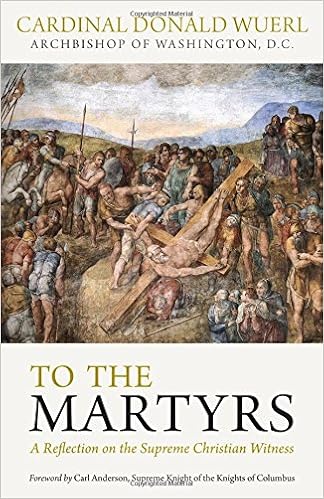
To the Martyrs by Cardinal Wuerl


Cardinal Donald Wuerl, Archbishop of Washington D.C., reflects on the plight and power of the Christian martyrs throughout the Church’s history in To the Martyrs: A Reflection on the Supreme Christian Witness.


Cardinal Wuerl takes us through the pages of Christian history in stages, from St Stephen in the book of Acts to those killed by the Islamic State. He powerfully makes the point that, while the age of martyrs can seem to be long ago and we may think “that can never happen here,” Christian martyrs are making the supreme sacrifice for the faith even today. In fact, being ready to become a martyr is expected of every Christian. 

Cardinal Wuerl describes how the anti-Christian regimes of the past used their power to suppress the faith and how those same methods are being used by governments and regimes in our time. His insight into the past can give hope for the future as Christianity has always outlived those powers.


We are reminded that communion with Jesus Christ is the goal of all who follow Him. Christians accomplish communion by participating in the Eucharist and by emulating ChristThose who are martyred enter into full communion because they emulate Him in suffering and dying as He did. Like Jesus' their deaths are live-giving. This essential tie between the Eucharist and martyrdom is beautifully made.

Another connection Cardinal Wuerl makes is that martyrdom is an unexpected source of unity among Christians.  Those who kill them do not distinguish between denominations or care about doctrinal disputes. The leaders of the Catholic Church and of other Churches find unity when responding to the death of their members.

This book calls all Christians into unity with those who suffer and die for the faith. He challenges us to support them, pray for them and fight for them. We must also pray for their persecutors in the hope of their conversion. Those who receive the Eucharist but do not act in communion with their brothers and sisters participate in the injustice. This reminder of the spiritual battle in which we are engaged is a timely one.